Lawmakers and world leaders bid farewell to an American original who leaves Republicans better positioned for the midterms - and Iran's rulers facing an uncertain future.
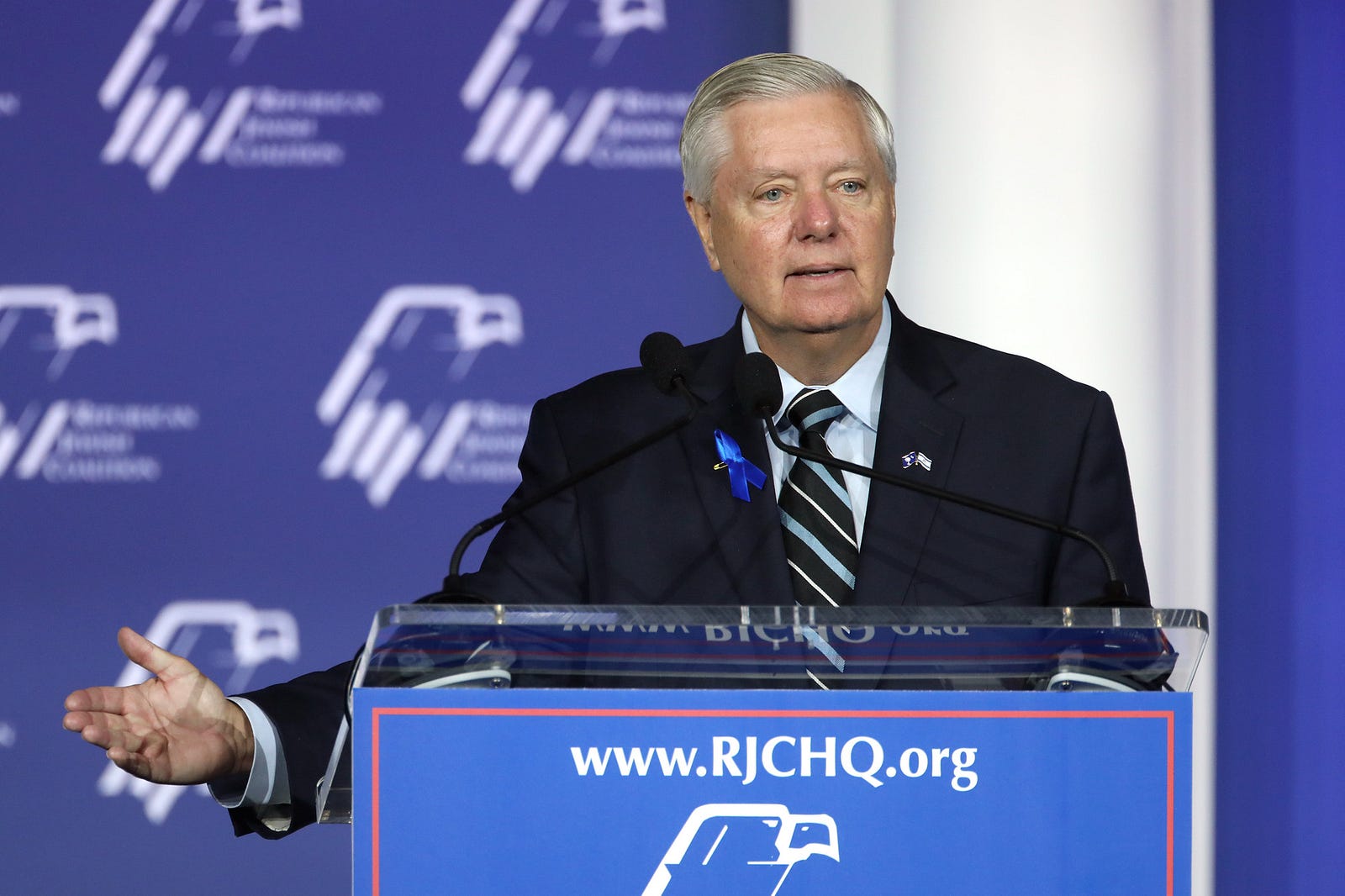
Washington said goodbye to Lindsey Graham on Tuesday with the kind of gathering that explained, better than any résumé could, the unusual reach of his life.
His flag-draped casket rested beneath the Capitol dome before being carried to Washington National Cathedral. Senators from both parties attended. So did President Donald Trump, Vice President JD Vance, Supreme Court justices, Cabinet officials, Israeli Prime Minister Benjamin Netanyahu and Ukrainian President Volodymyr Zelenskyy.
Few senators could have assembled such a congregation.
Trump called Graham a “true American original,” a “giant of the United States Senate” and a man who never lost the old-fashioned American idealism that first carried him from his parents’ pool hall in Central, South Carolina, to the center of world affairs.
That idealism is what makes Mr. Smith Leaves Washington an appropriate farewell, even though Graham was hardly a political innocent by the end. He understood Washington as well as anyone. He knew how to work a television camera, persuade a president, save a judicial nomination, cultivate a foreign leader and maintain a friendship across an ideological divide.
But beneath all that sophistication remained a nearly guileless faith in politics itself. Graham believed a senator could still alter history.
He also believed in the power of the United States of America to be a force of good in the world.
President Donald Trump joked at the funeral that Graham “never saw a war that he didn’t like,” adding that Graham always wanted strength used for the good of the country.
It was an affectionate exaggeration that nevertheless captured a real argument surrounding Graham’s legacy. He was one of Washington’s most energetic advocates for Israel, Ukraine and a forceful confrontation with Iran. He tended to fear the cost of inaction more than the risk of intervention.
Yet Graham’s hawkishness was rooted in optimism. He believed America was powerful enough to defend its friends, defeat its enemies and leave oppressed people freer than it found them.
The tenderness beneath the fighter emerged throughout the day.
Trump recalled that Graham carried his mother’s ring and his father’s putter, both of which were beside him when he died. Graham’s niece, Emillie Boggs Roberts, described him as unquestionably a family man. After losing both parents as a young adult, Graham became the legal guardian of his teenage sister, Darline. He considered the woman she became his proudest accomplishment.
Now Darline Graham temporarily occupies the Senate seat her brother held for more than two decades. The sister he raised is carrying forward the public trust of the brother who raised her.
Vice President Vance offered perhaps the best story of the day. He remembered having a fierce disagreement with Graham over Ukraine and assuming it would cost him Graham’s help on a separate rail proposal. Instead, Graham became one of the legislation’s strongest supporters.
When Vance asked why, Graham replied that he did not care much about the bill — but Vance did.
That was Lindsey Graham’s Senate at its best. He could fight against you on Monday and fight for you on Tuesday. He did not require agreement on every subject as the price of cooperation on any subject.
Washington will miss that quality.
Republicans will also miss Graham as they enter a difficult midterm campaign without one of their most experienced strategists, fundraisers and presidential intermediaries. He understood congressional politics, but he also understood Trump. For years, Graham translated the priorities of senators, military leaders and foreign allies into arguments the president might find persuasive.
Still, Graham leaves his party in a stronger position than conventional wisdom might suggest.
Republicans have only a narrow House majority, and the president’s party ordinarily loses ground in a midterm election. Public frustration over the Iran war, gasoline prices and the cost of living remains a serious threat. Democrats continue to hold an advantage in national congressional polling.
But elections are decided district by district, not by historical averages alone.
Republicans have improved the House map through redistricting. Their campaign organizations possess enormous financial reserves. Recent legal changes allow party committees to coordinate spending more effectively with candidates. The GOP does not need to produce a sweeping national wave. It needs to defend enough fortified districts to survive.
Across the aisle, Democrats have political opportunity but little agreement about what to do with it.
The Democratic establishment remains unable to explain convincingly why voters should choose it beyond opposition to Trump. The party’s socialist left offers more ideological energy, but its national platform includes proposals to abolish the Senate, subordinate the Supreme Court to Congress, replace the presidency and eventually eliminate prisons.
Most Democratic candidates do not support all those positions. Republicans will nevertheless ensure that they are asked about them.
Meanwhile, Democratic National Committee Chairman Ken Martin faces criticism over management, fundraising and the party’s troubled review of its 2024 defeat. The DNC has raised substantial sums, but it has spent heavily, accumulated debt and entered the closing months of the campaign with a fraction of the cash held by the Republican National Committee.
Republicans have political headwinds but a machine. Democrats have political wind at their backs but no settled destination.
Graham’s greatest unfinished campaign, however, lies beyond the midterms.
The Islamic Republic of Iran has not fallen. Graham’s expectation that Iranian cities might quickly slip from the regime’s control proved too optimistic. External attack strengthened Iranian nationalism in the short term and gave Tehran another justification for crushing dissent.
But the regime’s survival should not be mistaken for stability.
Iran remains governed through censorship, surveillance, imprisonment and execution. Its educated, urban population has repeatedly demanded greater freedom. Its economy is weakened, its leadership has been battered and its claim to religious legitimacy has worn dangerously thin.
The current pause in fighting may eventually do what bombing alone could not. Once the emergency recedes, Iran’s rulers will again have to explain why a wealthy, ancient and highly educated nation remains isolated, impoverished and afraid of its own young people.
Graham may therefore get his wish, but not exactly his way.
The Islamic Republic may not collapse under American bombs. It may instead lose its grip gradually as peace removes its excuses, economic recovery rebuilds Iranian civil society and the country’s internal demands for accountability return.
Trump said that, near the end, Graham had come to believe a deal might be better than destroying what remained of Iran. That would be a fitting final evolution for a man whose faith in American power was ultimately inseparable from his faith in human freedom.
Lindsey Graham leaves Washington with many of his campaigns unfinished. Republicans still have a majority to defend. Ukraine still has a war to win. Israel still seeks a durable peace. Iranians still wait for a government worthy of their civilization.
But Graham leaves each cause in motion.
That is no small legacy for the boy from behind the pool hall who rose to become, in Trump’s words, one of the most important men in the most important country on Earth.
(Contributing writer, Brooke Bell)